
The Federal Aviation Administration said Sunday that a radar site in Amarillo is one of two locations it is investigating as possible sources of a network disruption that prompted Friday’s nationwide ground stop, which halted departing flights across the country, including at Lubbock Preston Smith International Airport.
The agency has not confirmed that the Amarillo site caused the stop. In a questions-and-answers statement posted Sunday, the FAA said its “initial investigation indicates that two potential locations as the reason for the excessive data flooding the systems: a radar site in Amarillo, Texas and a radio communications site in El Dorado, Arkansas.” The FAA and its network contractor, L3Harris, “continue to investigate the root cause,” the agency said. KFDA NewsChannel 10 in Amarillo reported the local angle Sunday afternoon, and the Associated Press, carried locally by KCBD, and USA Today also reported the two-site investigation, citing the FAA.
What the FAA says happened
The FAA said it experienced a technical problem at about 3:30 p.m. Eastern (2:30 p.m. Central) on Friday, Nov. 13. A command-center order then ground-stopped all U.S. airports at 2:54 p.m. CT, according to our earlier reporting.
In Sunday’s statement, the FAA said its “legacy equipment became unstable when data began flooding the FAA FTI network, at a rate of 1,000 connection attempts every 4 to 5 seconds.” The agency said: “This disrupted the system and created instability with aircraft communications and radar feeds.” The problem showed up at 17 of the FAA’s 22 Air Route Traffic Control Centers, the agency said. It issued the nationwide stop “out of an abundance of caution,” said this was not a full outage, and said about 3,500 aircraft already in the air landed safely. The FAA said it has “no indication that this was a cyberattack or an outside nefarious actor.”
L3Harris “had been doing work at the El Dorado site, including deployment of a new router,” the FAA said. “When these inconsistencies in the data happened, L3 Harris blocked those two locations and the network stabilized.” The agency also disabled the broadcasting function on all the new routers as a precaution. Air traffic resumed at 8:15 p.m. Eastern Friday, or 7:15 p.m. Central, the FAA said Sunday. Some newsrooms on Friday reported slightly different lift times, which we noted in our earlier story.
The two sites, still under investigation
The FAA has not said which of the two sites, if either, was the origin of the data flood.
U.S. Transportation Secretary Sean Duffy described work at the Arkansas site and then problems in Amarillo. ABC 7 Amarillo (KVII) quoted him as saying: “So the work was being done in El Dorado, Arkansas. This was, we were replacing an old copper wire, which, by the way, was gonna be discontinued. They were gonna shut the line down, so we had to do this work.” He continued: “When we turned that router on, we saw that in Amarillo, a system we had replaced about three weeks earlier, that started to flood our system as well. So we’re looking at those two issues and trying to find the root cause of what happened.”
On CBS’s “Face the Nation,” Duffy said the FAA and L3Harris are examining routers from both sites in a test lab in Florida, USA Today reported. “When we know what the root cause of this issue was – was it the install from L3Harris? Was it the router? – I’m going to tell you and the American people what we find,” Duffy said.
ABC 7 Amarillo reported the site sits next to Highland Park High School and described it as a Remote Center Air/Ground Communication facility. The FAA’s Sunday statement called it “a radar site in Amarillo, Texas,” and did not give a street location or that facility type. We have not independently confirmed the Highland Park location.
What it meant for Lubbock flights
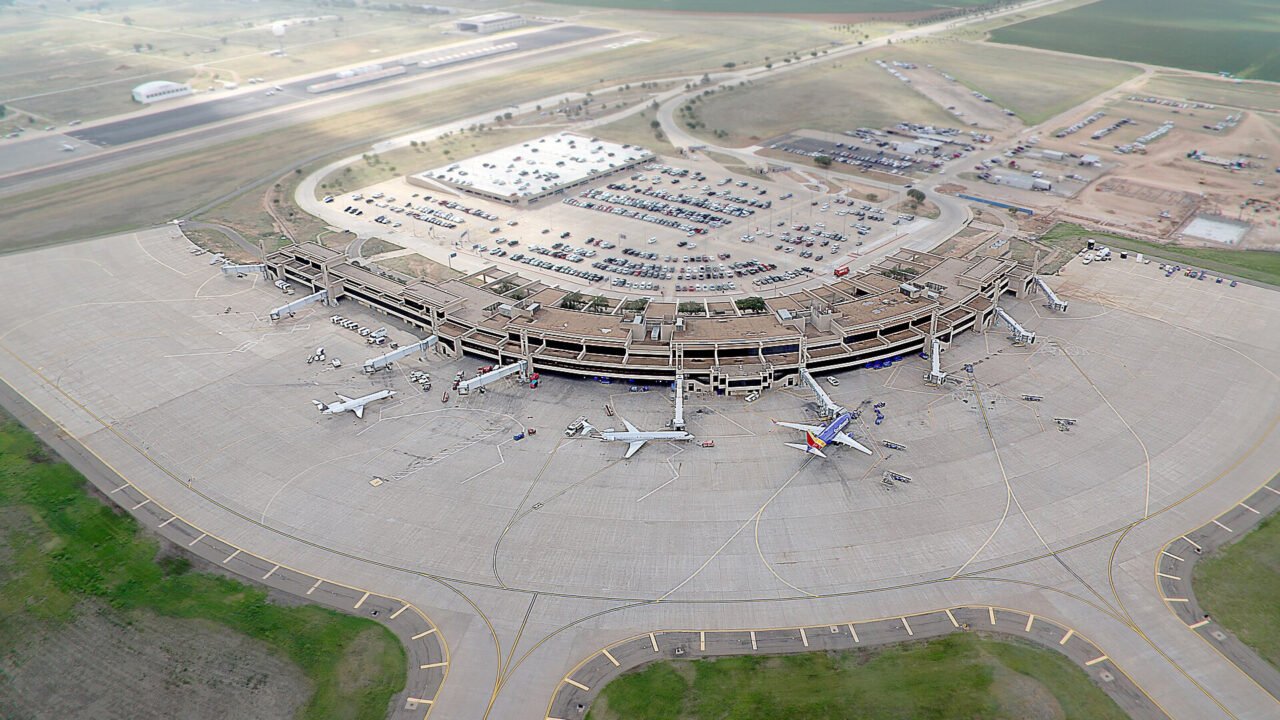
The nationwide order applied to Lubbock Preston Smith International Airport. Kelly Campbell, the airport’s executive director, said Friday that the grounding would affect Lubbock and that passengers should check with their airline, EverythingLubbock (KLBK/KAMC) reported. We have not seen a new statement from the airport or the City of Lubbock since the FAA named the Amarillo site on Sunday.
In our Saturday update, FlightAware listed eight cancellations and seven delays at Lubbock as of 2:18 p.m. CT Saturday. Weather later Saturday was also a factor, so those disruptions should not all be blamed on Friday’s ground stop. We have not independently confirmed Sunday’s Lubbock cancellation counts. Nationally, the FAA said operators canceled about 12,462 flights on Friday, including 9,082 by major airlines, and that not all were caused directly by the ground stop. The Associated Press, citing Cirium, said just over 1,300 of more than 26,000 flights scheduled for Sunday had been canceled.
What’s next
The FAA said Sunday the system is stable and operations are returning to normal, with recovery gradual as airlines work to get passengers to their destinations. The agency said it believes it addressed the initial disruption by disabling “the functionality of the originating routers,” and that, as a precaution, it disabled the same functionality on about 60 similar routers. The FAA and L3Harris “continue to investigate the root cause and ensure this doesn’t happen again,” the agency said. Passengers should check their airline and the FAA’s National Airspace System status page for current conditions.