If you are roasting a turkey in Lubbock this Thursday, a food thermometer and the clock matter as much as the recipe. Raw turkey can carry Salmonella and Clostridium perfringens, the CDC says, and those outbreaks show up most often in November and December, often after holiday food is left out too long. You cannot see, smell or taste the bacteria, the USDA’s Food Safety and Inspection Service says.
What it costs: The American Farm Bureau Federation’s 2026 survey puts a classic Thanksgiving dinner for 10 at $58.63, about $5.86 a person and up 6% from last year. A 16-pound turkey runs about $23.68 ($1.48 a pound, up 10%), but the total is still below the 2022 record of $64.05.
Planning the whole holiday? Our Lubbock Thanksgiving and Black Friday guide has local events, store hours and Small Business Saturday deals in one place.
Buying and thawing
Buy a frozen turkey if you are shopping more than a couple of days ahead, the USDA says. A “fresh” turkey has never been chilled below 26 degrees and, unless a “best by” or “use by” date reaches Thanksgiving, should be bought only one or two days before you cook. If there is no date, Tuesday or Wednesday is the earliest. Texas A&M AgriLife Extension recommends about 1 to 1 1/2 pounds per person, and checking that the bird will fit in your refrigerator and oven.
Do not thaw a turkey on the counter or in hot water. In the refrigerator, allow about 24 hours for every 4 to 5 pounds, at 40 degrees or below, in a dish on a low shelf. A 20-pound bird needs four to five days, the FDA says, and a thawed turkey can stay in the fridge one to two days before cooking. For a faster thaw, keep the bird in its wrapping, cover it with cold water, change the water every 30 minutes, allow about 30 minutes per pound, and cook it immediately.
Prep, cook and stuffing
Wash your hands with soap and water for 20 seconds before and after handling raw turkey, keep it away from foods that will not be cooked, and wash boards, utensils and counters with hot, soapy water. Do not rinse the raw bird; washing can splash bacteria around the kitchen, and federal agencies have advised against it since 2005, the CDC says.
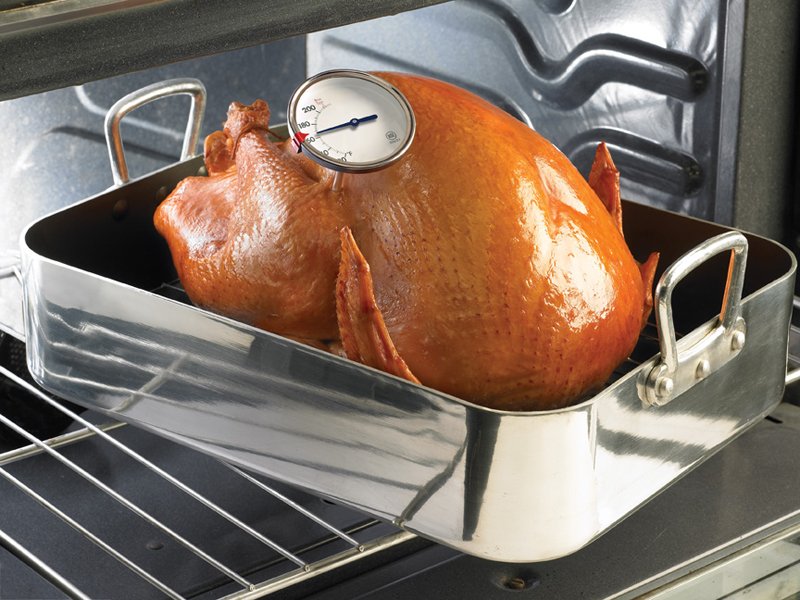
Set the oven to at least 325 degrees. Color is not a reliable sign of doneness. Check three spots, without touching bone, for 165 degrees: the thickest breast, innermost wing and innermost thigh.
The USDA does not recommend stuffing a whole turkey. Bake stuffing in a casserole instead. If you stuff the bird, do it just before it goes in the oven, never the night before, and stuff loosely — the FDA says about 3/4 cup per pound. The stuffing’s center must also reach 165 degrees. Let a stuffed turkey stand 20 minutes out of the oven before you remove the stuffing, the CDC says.
Frying, smoking and fire safety
Thanksgiving is the peak day for home cooking fires, the National Fire Protection Association says, with more than three times the daily average. NFPA strongly discourages oil-based turkey fryers and suggests buying a fried turkey or using a fryer that does not use oil.
If you do fry, the USDA says to use a completely thawed, unstuffed turkey of 12 pounds or less, outdoors, with oil at 350 degrees, for about 3 to 5 minutes per pound. Measure the oil first with water so the pot does not overflow. The U.S. Fire Administration says to keep the fryer at least 10 feet from the house, on a sturdy, level surface and not under eaves, and to keep children and pets at least 3 feet away. Never leave hot oil unattended. Check for 165 degrees, then let it rest about 20 minutes. To smoke a turkey, use an 8- to 12-pound unstuffed bird, keep the smoker at 225 to 300 degrees, allow about 20 to 30 minutes per pound, and still cook to 165 degrees, the USDA and AgriLife say.
Serving and leftovers
Keep hot food at 140 degrees or warmer. Refrigerate leftovers within two hours of cooking, or within one hour if they have been sitting above 90 degrees. Carve the turkey and pack it in shallow, covered containers so it cools quickly; you do not have to wait until the food is cool, the CDC says. Leftovers keep in the refrigerator three to four days — this year, through Monday, Nov. 30 — according to the USDA, CDC, FDA and FoodSafety.gov. Freeze what you will not eat by then. Frozen leftovers stay safe indefinitely at 0 degrees or below, the USDA says, with best quality about two to six months. Reheat leftovers to 165 degrees, and bring gravy to a rolling boil.
If you need a meal instead of cooking one, the Salvation Army is serving a free Community Thanksgiving Day Lunch from 11 a.m. to 1 p.m. Thursday at 1111 16th St. Our Thanksgiving food help guide and Thanksgiving and Black Friday guide have more local options, hours and events.
Sources
- USDA Food Safety and Inspection Service, Your Safe Thanksgiving Guide, last updated Nov. 5, 2026: https://www.fsis.usda.gov/food-safety/safe-food-handling-and-preparation/poultry/happy-thanksgiving
- USDA Office of Communications, The Recipe for a Safe Thanksgiving, bulletin dated Nov. 13, 2026: https://content.govdelivery.com/accounts/USDAOC/bulletins/43288ab
- USDA FSIS, Turkey: Alternate Routes to the Table, last updated Feb. 19, 2026: https://www.fsis.usda.gov/food-safety/safe-food-handling-and-preparation/poultry/turkey-alternate-routes-table
- USDA FSIS, Leftovers and Food Safety: https://www.fsis.usda.gov/food-safety/safe-food-handling-and-preparation/food-safety-basics/leftovers-and-food-safety
- USDA FSIS, Turkey Basics: Handling Cooked Dinners, last updated Sept. 25, 2024: https://www.fsis.usda.gov/food-safety/safe-food-handling-and-preparation/poultry/turkey-basics-handling-cooked-dinners
- USDA FSIS, Turkey Basics: Stuffing: https://www.fsis.usda.gov/food-safety/safe-food-handling-and-preparation/poultry/turkey-basics-stuffing
- FoodSafety.gov, Cook to a Safe Minimum Internal Temperature, last reviewed Nov. 21, 2024: https://www.foodsafety.gov/food-safety-charts/safe-minimum-internal-temperatures
- FoodSafety.gov, Leftovers: The Gift that Keeps on Giving: https://www.foodsafety.gov/blog/leftovers-gift-keeps-giving
- CDC, Preparing Your Holiday Turkey Safely, April 29, 2024: https://www.cdc.gov/food-safety/foods/holiday-turkey.html
- FDA, Food Safety Tips for Healthy Holidays: https://www.fda.gov/consumers/consumer-updates/food-safety-tips-healthy-holidays
- Texas A&M AgriLife Today, Let the thaw begin: How to safely prepare your Thanksgiving turkey, Susan Himes, Nov. 14, 2023: https://agrilifetoday.tamu.edu/2023/11/14/let-the-thaw-begin-how-to-safely-prepare-your-thanksgiving-turkey/
- Texas A&M AgriLife Today, 5 ways to cook your Thanksgiving turkey beyond the oven, Torie Noellsch, Nov. 11, 2026: https://agrilifetoday.tamu.edu/2026/11/11/5-ways-to-cook-your-thanksgiving-turkey-beyond-the-oven/
- Texas A&M AgriLife Extension Service, Lubbock County office: https://agrilifeextension.tamu.edu/counties/lubbock-county/
- National Fire Protection Association, Thanksgiving Fire Safety Information: https://www.nfpa.org/education-and-research/home-fire-safety/thanksgiving
- U.S. Fire Administration, Turkey Fryer Fire Safety infographic: https://www.usfa.fema.gov/downloads/pdf/publications/turkey-fryer-fire-safety-infographic.pdf
- Ask USDA: https://ask.usda.gov/
- Wikimedia Commons / USDA Flickr, roasted turkey with food thermometer (public domain): https://commons.wikimedia.org/wiki/File:11.09.11_Turkey_top_questions_blog_-_Flickr_-_USDAgov.jpg
- American Farm Bureau Federation, Cost of Thanksgiving Dinner Increases, Remains Below 2022 Record High (41st annual Thanksgiving dinner survey): https://www.fb.org/news-release/cost-of-thanksgiving-dinner-increases-remains-below-2022-record-high